
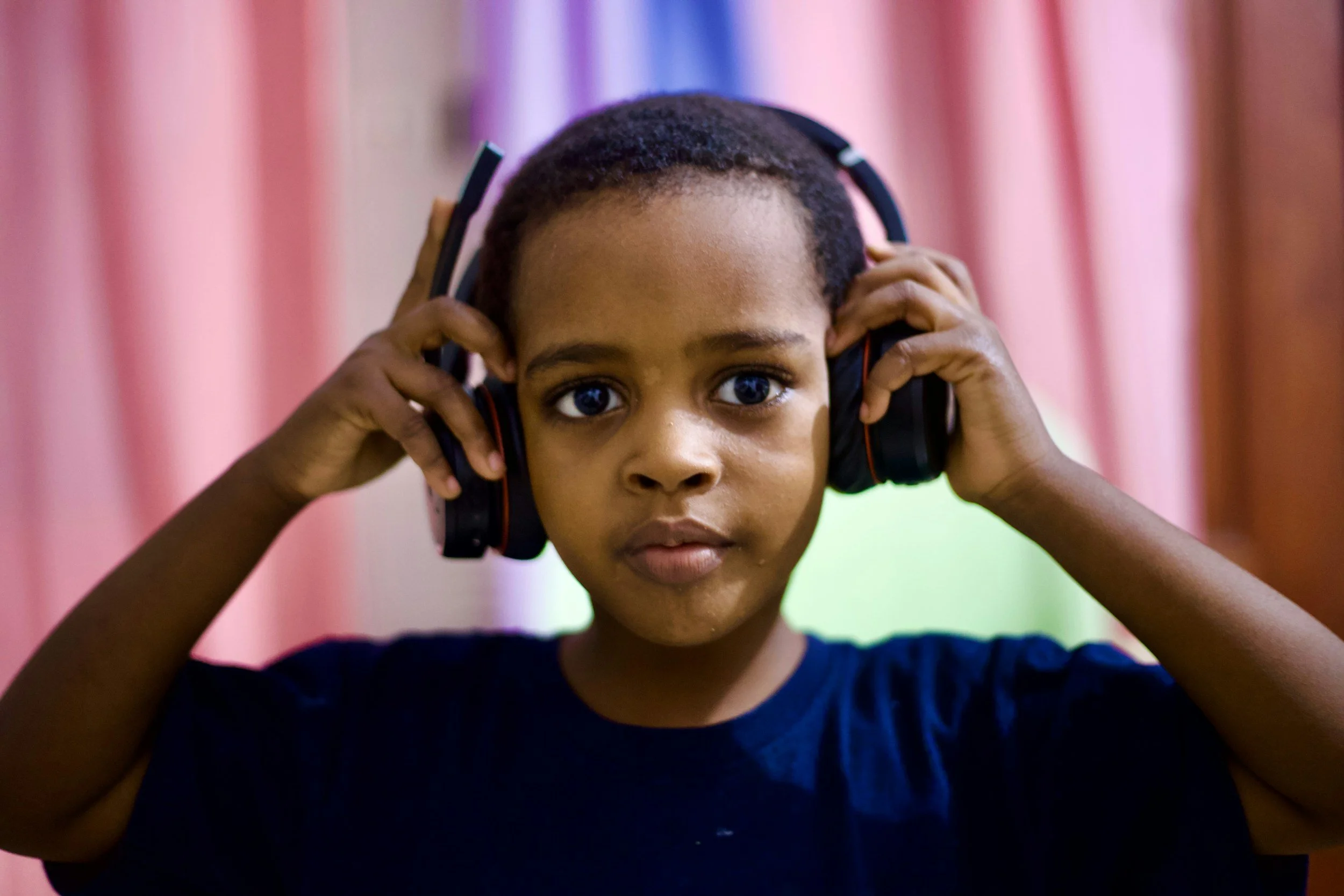
Is it a hearing issue?
Have you heard this term but are not really sure what it means or how it may apply to your child? Many parents will share concerns during a consult/intake session that their child has trouble “processing” or often misses what was said. Some have heard the term before, but no one has clearly explained what it means and who actually diagnoses it. One thing to know is that auditory processing is largely a set of skills, like language, reading, or riding a bike, that a child develops over time. So even if you think this may be an area of weakness for your child, it is not a deficit, but merely a skill that may require more support to be developed.
Some parents have asked me, “is this a problem with my child’s ability to hear?” And the answer is, no, not exactly. It is actually a difficulty with the brain's efficiency in processing the information that is accurately heard by the brain (difficulty with hearing sound is a separate medical condition). So, what actually is it?
Well, before we attempt to define auditory processing disorder (APD; sometimes referred to as central auditory processing disorder), I should acknowledge that there is some debate about how to define, assess for, and treat APD as there is no real standard diagnosis across professions, high overlap with other diagnoses, variability and inconsistent reliability in testing. Additionally, there is no universally accepted method for screening. On the other hand, as of recent, APD has gained more credibility because of the ability to link lesions in certain parts of the brain to reduced performance qualitatively and on formal measures.
APD is most often diagnosed by an audiologist or speech/language pathologist. Per the most recent (2010) practice guidelines from American Academy of Audiology (AAA) and American Speech-Language-Hearing Association (ASHA): APD refers to “difficulties in the perceptual processing of auditory information in the CNS…auditory processing requires refining, analyzing, modifying, organizing, and interpreting information that comes in through the peripheral auditory system, can result in poor performance in sound localization, auditory discrimination, pattern recognition, and auditory closure with competing sounds/signals.” It is generally agreed upon that APD can be diagnosed if scores on measures assessing auditory processing cluster two standard deviations below the mean (2nd percentile or lower) or if one or more skills fall three standard deviations below the mean (less than 1st percentile).
What does APD look like? One article (Bamiou etl al. 2006) explained that APD can present as “difficulty understanding spoken language in competing messages, noisy backgrounds or reverberant environments, misunderstanding messages, inconsistent or inappropriate responses, frequent request for repetition, difficulty following oral directions, difficulty localizing sound, or difficulty learning songs/rhymes.” More specifically and anecdotally, behavioral manifestations of APD can look like: difficulty understanding others with background noise, difficulty understanding where sounds originating from, poor tone/pitch in music, difficulty “hearing” prosody in speech/language, difficulty following directions, struggle when others speak quickly, frequent attempts for others to repeat what they have said, responses that don’t make sense with what was asked. Individuals with APD often have difficulty comprehending speech in noisy environments because of integrating sound coming from both ears, can be assessed via binaural masking or fusion tasks recognition of words in noise tasks, listening in spatialized noises test.
How can we evaluate for APD? It is imperative that peripheral (conductive and/or sensorineural) hearing impairments are ruled out prior to assessing for auditory processing deficits to ensure no peripheral hearing loss. Auditory processing and phonological processing measures are often only done for “screening purposes” in school evaluations; however, to assess for a formal auditory processing deficits, an “acoustically-controlled” environment is required, sometimes in conjunction with specialized equipment only offered by an audiologist. Auditory screening is recommended the early literacy stage (around preschool or kindergarten), as those who have APD typically require early identification and intervention. A proper evaluation would be able to identify difficulty with speech perception, can be assessed by temporal resolution screening task, figure-ground stimuli related to speech in noise, and dichotic digits tasks (assessing the potential discrepancy between processing of each ear as well as in conjunction). In terms of the specific tests administered, there has been much debate about what the “gold standard” may be for APD assessment. Perhaps the most preferred and commonplace measure across professions in the SCAN-3. This involves tasks pertaining to processing: competing words, gap detection, figure-ground, time compressed sentences, and filtered speech. Auditory closure (fill in the blank for sounds/words vs. fill in words within sentences in print) assessed by time compressed sentences, filtered words, and speech in noise and gap detection/interrupted speech. Additional tasks often include staggered and multisyllabic words (sound blending), phonemic synthesis (integrating phonemes), or dichotic digits tests (one ear at a time). Feather Squadron is a computer screening program (recommended by ASHA), which covers 5/6 recommended domains of auditory processing. More recently, there is a new screener out of Brazil called Audbility, which includes temporal auditory processing (SCAN-3 does not), as well as additional behavioral auditory tasks that assess 6/6 areas of the recommended domains by the ASHA. Regardless of the measures employed, once the assessment is complete, the clinician will interpret and conceptualize the test results and then develop and implement a management/treatment plan in conjunction with other professionals.
What about diagnostic overlap? There is an established connection between APD and dyslexia; however, many children who are dyslexic do not have auditory processing deficits. Those with co-occurring APD and dyslexia often struggle with sound discrimination and gap detection, both of which overlap with executive functioning deficits (common in both dyslexia and ADHD). Children with ADHD tend to do better on auditory closure tasks but not tasks with higher working memory (i.e., attention) or mental organizational demands, as there is a minimal correlation with auditory closure and attention/memory. When speech is masked by noise, many individuals are able to use auditory closure/perceptual restoration to infer what was said (if they have adequate language knowledge). Most children are able to do this by age 5, though not quite as well as adults. In terms of overall auditory closure, lexical knowledge was more important for success than working memory, and those with APD tend to do better with more dissimilar sounding words. One potential differentiator to aid in proper diagnosis is performance on visual temporal ordering and listening in spatialized noise tasks. These tasks are generally intact in ADHD, but compromised in APD. For example, take the word “cantaloupe.”- those with dyslexia and/or ADHD may struggle to separate the sounds, while someone with APD might incorrectly blend or process the individual sounds and hear “cantaloupe” as “antelope”, despite knowing the meaning of both words and knowledge of letter-sound associations. If a child has difficulty discriminating durations of sounds, this may affect phonemic awareness for sounds/words that differ in duration, especially for languages where tone/prosody is important to communicate meaning. If there is co-occurring difficulty with early reading/spelling skills there may be a learning disability (especially dyslexia) at play.
So, what can you do to help your child with APD? Two programs that have established research to support efficacy are: Fast ForWord and Earobics, which both target auditory and language processing skills. Additionally, these programs adapt items based on prior responses/ability. The LisN & Learn Program was shown aid in spatial processing of language and binaural integration. CAPDOTS is a dichotic/binaural listening training program which has been shown to improve processing of: multi-step instructions, messages in groups, listening with background noise, and auditory memory. Across these programs, there were generally minimal differences between auditory processing computerized programs. These programs can be done in office, at school, or at home. These programs are thought to work on brain plasticity in the brainstem to integrate sounds, improving communication across the corpus callosum, as many language processing tasks require both hemispheres. Of note, there is no evidence to show benefit from these programs upon academic achievement (i.e., reading, spelling), only auditory and language processing were improved in research studies. though they may help with consonant-vowel discrimination, there have been no consistent improvement on phonological processing/literacy skills. On the other hand, alternative sound-based programs (i.e., Berard auditory integration, Tomatis approach, Listening program) are not support by research as being effective and not supported by AAA or ASHA. Those with true APD require speech/language and specific strategies for encoding and recalling language-based information. Unfortunately, there is often a lack of intensive treatment/accommodations in the public school setting, so services may have to be contracted out and the need for services needs to be demonstrated by outside professionals in congruence with a multidisciplinary team for most progress. In the school environment, many children require different accommodations or modifications for different academic subjects. Personal FM systems, personal FM desktop, or low gain hearing aids may be helpful depending on student and their classroom environment, sometimes in conjunction with assistive tech or hearing services.Some require classification as a student requiring special education services, typically under Other Health Impairment (OHI), Speech/Language Impairment or Learning Disability. Children with APD benefit from others speaking slowly, emphasizing key words, waiting for responses, the use visual aids/written language when appropriate, and strategic seating placement. It is often helpful work on inferential skills, graphic organizers, improving vocabulary, active listening, meta-memory techniques, and self-advocating. Daily or close to daily training is recommended with systematic program (see above) and multiple tasks. Dichotic interaural intensity difference (DIID) training may also be recommended when lack of binaural integration to improve interpretation of prosody and learning sound-symbol associations. All in all, if you suspect your child may have APD, do not hesitate to begin the process for a public or private auditory processing evaluation and if your child is ultimately diagnosed, know there are many avenues and effective interventions to help your child be successful across settings.