
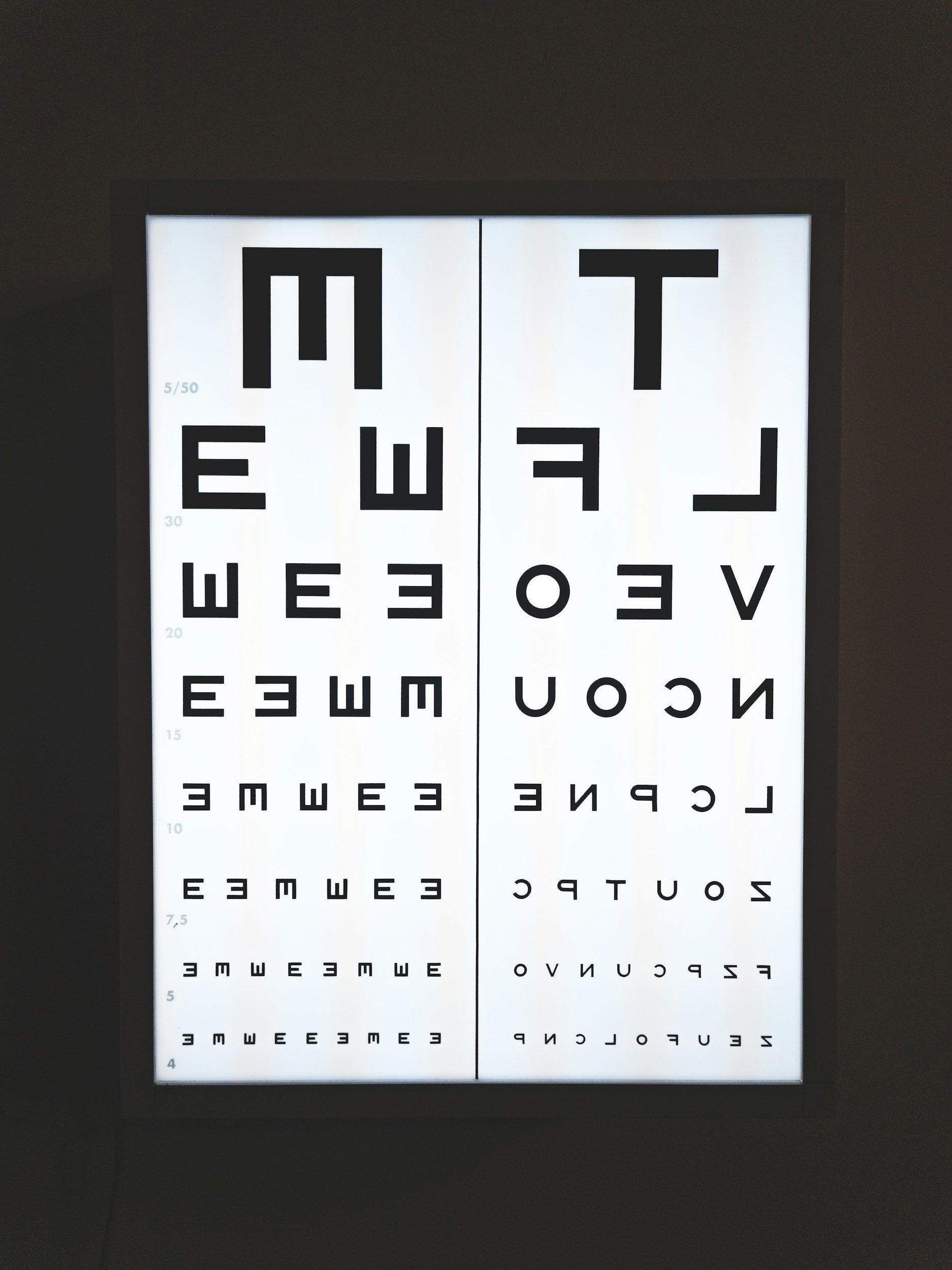
Should I be doing this for my child?
Vision therapy stems from a so called controversial branch of optometry called “behavioral optometry”, often claiming that vision therapy improves academic performance and self-confidence. Vision therapy can include eye exercises, body exercises, special glasses (prism, weak-plus lenses, tinted/colored lenses, and visual-motor based tasks.
Reversal of letters has been considered a sign of poor visual perception or reduced visual working memory, but there has been no greater frequency among reading impaired children. Occasionally, there is a mild relationship between visual perceptual skills and reading, though this is the minority for those who reverse numbers/letters and tends to be exacerbation rather than cause or due to lack of exposure/experience secondary to difficulty reading.
Many children, especially as of recently as I have observed in my own practice, have been diagnosed with convergence insufficiency by an optometrist. So, what does this even mean? Well, vergence is the ability to move the eyes outward or inward in a coordinated way so both eyes are fixed on the same target or word, for example. CI can reportedly result in eye strain, blurred vision, double vision, inattention, and headaches Some argue that it may be related to general visual impairment that can be corrected with glasses and does not contribute to reading difficulties. Additionally, it has been found that there have been an increase of convergence insufficiency diagnoses in ADHD and ASD populations; however, this may be due to inattention, language delay, or medications.
There has been some evidence for vision therapy for convergence insufficiency (but not as it pertains to reading or ADHD), also high cost, and not covered by insurance. However, no evidence that visual therapy for convergence insufficiency improves reading ability (fluency or comprehension) when compared to placebo in randomized controlled clinical trials. It should be noted that the few studies that support vision therapy tend to have conflicts of interest, non-randomized, and poorly controlled studies.
Additionally, there is been some benefit for individuals with a history of TBI who experience photosensitivity, deficits in accommodation, or vergences of field of vision as sports vision exercises (set of techniques using eye muscles for the developmental of visual function) have been shown to improve athletic performance. However, home-based computer vergence/accommodative therapy (12-weeks) with children with convergence insufficiency showed no evidence of positive improvement.
Now in terms of the physical act of reading, there has been evidence of some differences in the way the eyes function. Children with dyslexia: shorter saccades, increased backward saccades, and longer and more frequent fixation pauses. Fixations are an essential part of reading, each fixation is complemented by a saccade and those with dyslexia often fixate on the same word repeatedly (that is, processing each aspect of word individually, less automatic); however, this appears to be a result of poor reading rather than the other way around.
Reading is actually not accomplished by visual tracking (slow smooth pursuit eye movements following a target from one point to another). In fact, one study revealed no difference between poor and normal readers on visual tracking of non-verbal stimuli. Moreover, per the research, children with congenital neurological disorders, which result in abnormal eye movements, do not have an increased rate of reading difficulties, including dyslexia.
In fact, in 2011, there was a joint technical report on learning disabilities, dyslexia, and vision from the American academy of pediatrics, American academy of ophthalmology, American association of pediatric ophthalmology and strabismus, and American association of certified orthoptists stating: “There is inadequate scientific evidence to support the view that subtle ye or visual problems cause or increase the severity of learning disabilities…scientific evidence does not support the claims that visual training, muscle exercises, ocular pursuit-and-tracking exercises, behavioral/perceptual vision therapy, training classes, prisms, and colored lenses and filters are effective direct to indirect treatments for learning disabilities”
Similarly, in 2014, the royal Australian and new zealand college of opthalmologists released a policy statement on learning disabilities, dyslexia, and vision stating: “Primary dyslexia and learning disabilities are complex neurocognitive conditions and are not caused by vision problems… there is no evidence to suggest that eye exercises, behavioral vision therapy, or special tinted filters or lenses improve the long-term educational performance of people affected by dyslexia or other learning disabilities”
Tinted/colored lenses promoted by Irlen to treat “Irlen Syndrome” (diagnosis of exclusions with little to no empirical support, no ophthalmological abnormalities) to relieve “pattern glare or visual stress” which allegedly interfere with reading (muscle strain, blurring, light sensitivity, headaches, dizziness), implies issue with rods in retina in dim conditions, though reading is largely done with cones in retina in light conditions
In 2018, the royal Australian and new Zealand college of ophthalmologists released a policy statement on Irlen Syndrome noting the “critical lack of scientific evidence supporting the efficacy of colored filters or overlays in the improvement of reading and could not endorse the treatment.”
“Dyslexia-friendly” fonts: OpenDyslexic (no improvement), ReadRegularTM, EasyReading (no to minimal improvement), Sylexiad, Dyslexie (mostly differences between openings in letters, enlarged ascenders and descenders, increased x-height, more space between letters, and weighted bottoms; no to minimal improvement). All have mixed to minimal evidence, word spacing and body size/longer ascenders and descenders appear to have most significant benefit, but inconsistent. And in terms of potential misinformation, one study found that #visiontherapy yielded 59,000 results on instagram, though only about 50% provided accurate information (most by eyecare companies, mostly those with “personal experience”, those with most likes).
In sum, vision therapy is low-risk medically but high-risk financially and emotionally (false hope) and can defer truly effective therapies. Importance of intervening early (identification in kindergarten, intervention prior to third grade), not being derailed by ineffective treatments, and knowing what works (multisensory instruction, explicit spelling instruction etc.) It is strongly encouraged that you get a second opinion by a pediatric ophthalmologist if a vision disorder is suspected.